
You are more ready than you think. A beginner's guide to US air gun competition.
Part 3 of 3. A beginner's guide to US air gun competition.
Last updated: October 2026. Fees and calendar dates change, so check current details before relying on them.
Part 1 covered why a first match is worth entering before you feel ready, and how to tell that you are ready. Part 2 covered choosing your match, the registrations you need, and finding and entering a match. This part covers what entry and travel cost, how to get a match gun to the line, how a match day runs, the questions first-timers ask most, and equipment control. The rules referred to are those of the ISSF (International Shooting Sport Federation): USA Shooting events run under them, and the CMP (Civilian Marksmanship Program) rulebook follows them closely for the 60-shot events.
Fees, Travel and Getting a Gun
What entry and travel cost for a first match, and how to get a match gun to the line. Figures are from October 2026 and change from year to year.
Entry fees vary more than newcomers expect, and not always in the direction you would guess. A club match or a CMP monthly match typically runs $20 to $25 in 2026, and USA Shooting's monthly match in Colorado Springs around $30 to $40 for the first event. CMP events are notably affordable even at the national level: the Camp Perry Open, one of the largest air gun championships in the country, charges $60 for the 60-shot air pistol event at its January 2027 match. USA Shooting championships and selection matches sit at the other end, running well over a hundred dollars. Travel and lodging, not entry, will usually be your largest line item.
One thing to know before you plan a trip: flying with an air gun is not as straightforward as it sounds. It is not something you carry on, and airlines handle it much the way they handle firearms. Read your airline's policy before you book, and give yourself extra time at the counter. The air cylinder is the part most likely to cause trouble: the TSA (Transportation Security Administration) allows an air gun in checked baggage only without the cylinder attached. Our recommendation is to ship the cylinder separately, empty. Our in-depth guide to traveling with your equipment is in the final stages of preparation and will cover this in detail.
Equipment is where newcomers assume the real cost lies, and it is where they are most often wrong. You do not need a top-tier match gun to enter your first competition. A second-hand or borrowed match-quality gun will get you to the line. The common case is that you have been training on a club gun you cannot take to the match. A rental or loaner is usually available, so reach out to the match organizer or the host club ahead of time and arrange one. The CMP has two competition centers, at Camp Perry, Ohio, and Anniston, Alabama, which rent air rifles for $5 to $10 on top of their $10 adult daily range fee. Ask ahead about pistols in particular. Owning your own gun is still a benefit, because you train and compete on the same equipment.
One caveat: a match should not be the first time you have ever fired a match air gun. Come in having practiced, even if the gun on the day is not yours. CMP ranges let you practice for $10 a day, with your own gun or a rental, which is also a good way to try different models before you buy. So is your club, if other shooters there own different models and will let you try them.
What a Match Day Looks Like
How a match day runs, from check-in to the final.
The shape of the day is simple. You arrive early and check in, which confirms you against the entry list and tells you your firing point. Most matches run a single relay. At larger ones there are more shooters than firing points, so the field is split into groups that shoot one after another, called relays, and you may not be in the first. Your relay is assigned when you register or check in. You set up at your firing point and get a preparation and sighting period, usually 15 minutes, with as many sighting shots as you like. The targets then switch to match mode and you fire your 60 competition shots inside a set time, at your own pace. Scores go up, awards happen if the match gives them, and you go home. At a monthly match you will typically be finished by early afternoon.
A championship spreads that over several days. The first day is usually PET, pre-event training: you arrive, check in, and are given a window with the range reserved for you to practice on. If you have arranged a rental or loaner, this is also your chance to dial it in before the match. Where the match runs equipment control, it normally sits on the same day. Then come two separate 60-shot matches on separate days, each a real match with its own result, followed by the final either after the second match or the next day.
The final takes the eight best combined totals from the two match days. Occasionally some matches do it differently, so check the match program. A final does not use the qualification format at all, so it is worth watching a couple online from world-level events, a World Cup or an Olympic final, in case you make it on your first try. That does happen, particularly at smaller matches where a final still runs but the field is small. Some matches also add unofficial final-format events so that more people get to take part, so check the match program.
Everything else people worry about is answered below.
Common Questions
Short answers to the questions first-timers ask most.
Do I need a membership before I can shoot my first match?
For a CMP match, no: you need only a free Competitor Number, one per person. For a USA Shooting event, yes: its sanctioned events require paid membership. Local club matches generally need neither. See What You Need to Enter (Section 3).
What do I bring?
The ISSF rules do not require eye protection at 10 m, but some ranges do. Hearing protection is optional with air guns: plain earplugs or muffs are fine if the noise distracts you. Anything with sound-enhancing or receiving features is not allowed under ISSF rules, which rules out wireless earbuds and active noise-canceling headsets. Where a match enforces the rules strictly, you will be told to remove them, and keeping them on can cost you points and, in the end, disqualification. The match program will tell you anything specific to that event, including whether there is a fill station on site.
Can I train for this at home?
Yes. Under US federal law, match air guns are not classified as firearms, so a 10 m lane with a proper pellet trap in a basement or garage is achievable almost anywhere. Some states and cities do regulate air guns, so check your local rules. Even without 10 m of distance, you can practice against scaled reduction targets at a shorter distance. Our guide to building a home air gun range covers the whole build.
Will I be shooting on electronic targets?
Probably, at a sanctioned match. They work much as paper does from your side of the line, with a monitor at your firing point instead of a target downrange. There is one thing worth knowing in advance: electronic target faces are lit, and brighter than paper, which changes your sight picture. If you have never shot on them, get one practice session on an electronic system before the match rather than meeting it on the day.
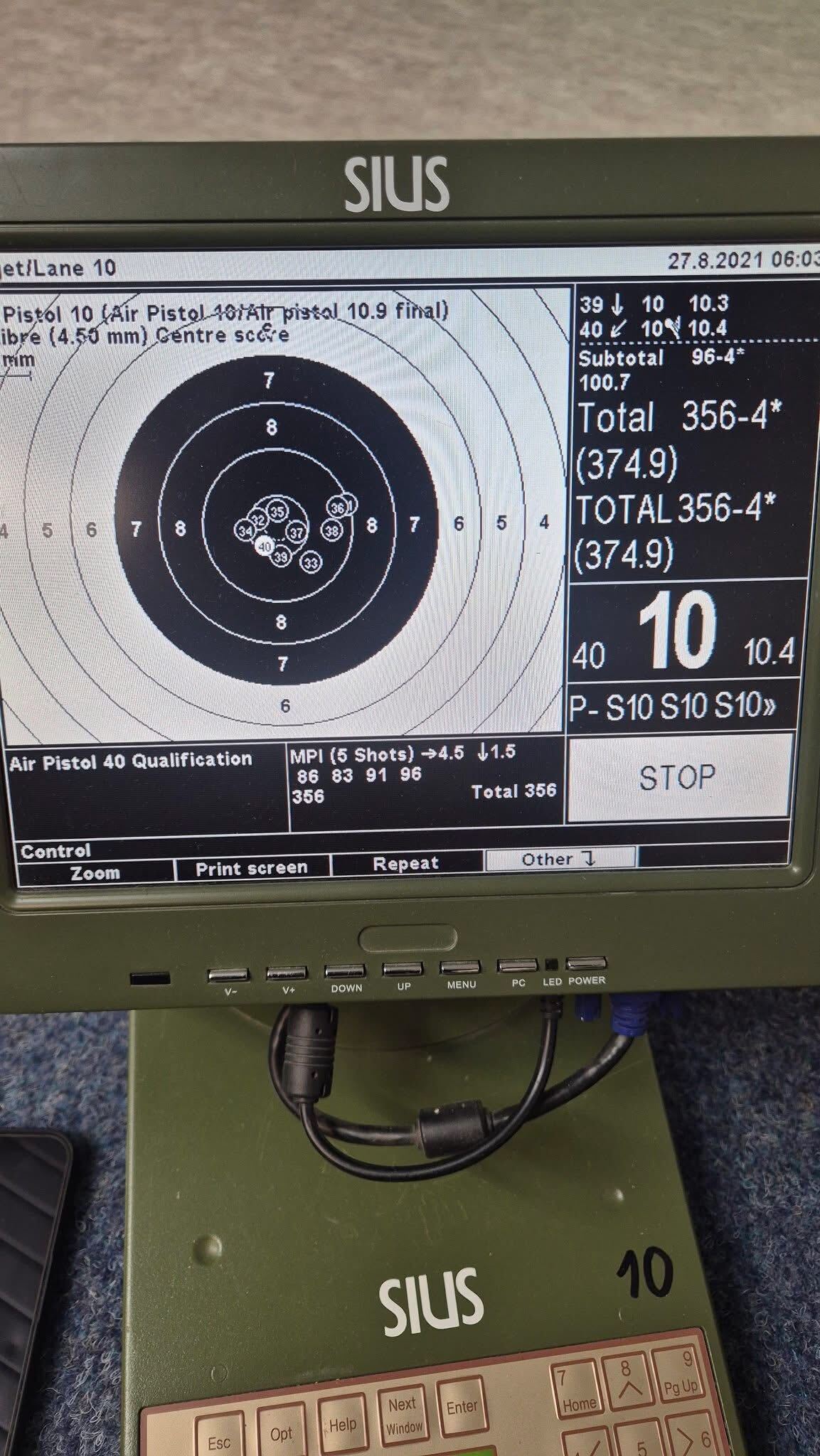
The monitor at your firing point shows each shot as it lands.
How do I know when to start shooting?
The range officer starts each period with a command: first "PREPARATION AND SIGHTING TIME... START", then "MATCH FIRING... START". After that, nobody will tell you anything. There is no command to load and no instruction before each shot. You load and fire when you are ready, and the pace inside that window is entirely yours. A first-timer waiting for an instruction that is not coming loses several minutes.
What is a final, and will I be in one?
A final is a separate event from the qualification you just shot. Under ISSF rules it starts from zero, so your qualification score does not carry over, though a few formats work differently, so check the match program. Every shot is scored in tenths, and a range officer controls the pace shot by shot. It is usually a cut to eight, so you are unlikely to be in one in your first season. Stay and watch anyway: you see the format before you ever have to shoot one, and afterwards the finalists, coaches and other shooters are around and generally happy to talk (more in Why Compete, and Why Now). What a Match Day Looks Like (Section 6) covers how finals fit into a championship.
What if I am the slowest or lowest-scoring person there?
You will not be the first, and nobody is keeping track except you. Your score at a first match does not matter. There is no judging, and you are shooting against your own personal best, not against the people beside you. What counts is carrying out your process under pressure, and doing that early. Shooters well below the scores you see in results enter open matches regularly and get more out of them than anyone. Classification and score requirements apply to selection matches and certain national championships, not to the matches you will be entering first.
What happens if my gun malfunctions, or something goes wrong?
Sooner or later something will: the gun jams, two pellets go in by accident, a pellet loads backwards. None of it is unusual and none of it is an emergency.
Stay calm, and do not start improvising repairs under the clock. Stay at your firing point, keep the gun pointed in a safe direction, and raise your hand. You can look back over your shoulder to draw attention, as long as the gun stays pointed safely. A range officer will come to you, you explain the problem, and you follow the instructions they give. They deal with this constantly. Asking is always right. Guessing is not.
If your cylinder runs dry, you do not need a range officer to come to you. Unload the gun, open the action, put your safety flag in and leave it at your firing point, then tell the range officer you are going to refill or change the cylinder, and go. The clock keeps running while you are away, so start the match with a full cylinder.
You can leave the line during the match. The same steps apply to a restroom break or to leaving altogether: make the gun safe, tell the range officer, and go.
What if I fire on the wrong target?
Then it is a crossfire, and the shot is scored as a miss. If you fire and nothing registers on your target, do not fire again to test it. Raise your hand and wait for a range officer, as you would for any other problem.
What if a stop is called?
Only range officers call a stop. When one does, stop firing immediately, keep the gun pointed downrange, and follow their commands. Do not remove the gun from the firing point or step away until they tell you to. You do not call a stop yourself. If something is wrong, raise your hand, tell the range officer, and let them decide what happens next.
A Note on Equipment Control
Optional reading for a first match: what equipment control checks, and when it applies to you.
Where a match runs equipment control, officials check guns and gear against the rules before you shoot. Club matches do not run it. Larger matches may or may not, and the match program will tell you. USA Shooting championships check equipment before the match, and officials can also run random checks during it. With the Los Angeles 2028 Games coming, matches in the US are trending stricter and closer to the ISSF rules, so expect it more and more at championships, especially the larger ones. For pistol it means trigger weight, dimensions and the grip. For rifle it means the jacket and trousers, the shoes, the glove, and the rifle itself. The details are in the ISSF rulebook.
If you are shooting current equipment as it came from the manufacturer, this is a formality and there is nothing to worry about. One thing is worth knowing: the ISSF rulebook was revised in winter 2025-26, and that revision changed the pistol grip rules. A pistol made, or a grip shaped, before then is worth checking ahead of a large championship. The same revision changed the rifle clothing rules, so a jacket or trousers bought before 2026 are worth checking too.
If you have already started modifying your own equipment, that is normal, and the check is simple. A pistol, with everything fitted, must still fit inside the measuring box, which has to close with the pistol inside it. A rifle is measured against the maximum dimensions in the rules.
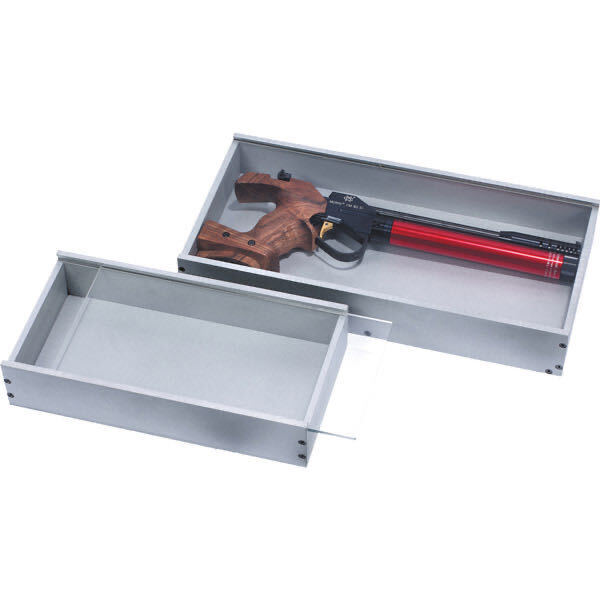
Equipment control: the pistol, with everything fitted, must fit inside the measuring box.
Keep Reading
Two more guides in our Resources section pick up where this one leaves off.
- Beginner's Guide: Building a 10 m Airgun Range at Home, for setting up a place to train between matches.
- The Ultimate Guide to Choosing the Perfect Pistol Grip for Sport Shooting, for pistol shooters working on fit and consistency.
Help Us Keep This Guide Current
We keep this guide up to date, and we would appreciate your help with that. Fees, facilities, calendar dates and rules all change. If you spot anything worthwhile that we missed, an error, or a change to the regulations or to anything else we reference, please contact us at sportshootingdepot.com/contact-us. Every note helps us keep the guide accurate and current.
Disclaimer
This guide shares what has worked for us and for other shooters. It is not legal or professional advice. Entry requirements, fees and rules are set by the organizations that run each match, not by us, and they change. You are responsible for following the laws and rules where you live, and for checking the current match program and rulebook before relying on any rule described here.
References
Rules and figures in this guide were verified in October 2026 against the sources below.
Rules
- ISSF Rule Book, Edition 2025 (Second Print 07/2026), effective 1 July 2026: General Technical Rules 6.2.3.1 (range commands), 6.2.5.1 (hearing protection), 6.11.1 (commands), 6.11.2.3 (air cylinders), 6.11.6.1 (crossfire), 6.11.9.1 (scoring), 6.12.5.3 (leaving the firing point), 6.12.6.1 (penalties) and 6.17 (finals); Rifle Rules 7.7.4 and Pistol Rules 8.11 (time limits); Pistol Rules 8.4.1.5 (measuring box).
- ISSF Rifle Equipment Control Guide, Edition 2026, and Explanation of New Pistol Grip Rules 2026, both on the ISSF Amendments and Interpretation page, and the ISSF announcement of the 2026 rule changes, for Section 8.
- CMP Air Rifle and Air Pistol Competition Rules, 5th Edition (2026), effective 1 March 2026.
Programs and calendars
- CMP Competition Tracker, for match listings.
- CMP: Register for a CT Number, for competitor number registration.
- CMP Monthly Match Program, for the monthly match schedule.
- CMP Competition Centers: public shooting, for daily range fees and rental rates.
- CMP Camp Perry Open, for the air pistol entry fee.
- CMP Air Pistol Nationals, Alabama Airgun and Smallbore Cup and the Walther Cup, for open championships.
- USA Shooting events calendar and membership.
- USA Shooting SafeSport, for SafeSport and background check requirements.
Travel
- TSA: Compressed Air Guns, for checked baggage and air cylinders.