
You are more ready than you think. A beginner's guide to US air gun competition.
Last updated: October 2026. Fees and calendar dates change, so check current details before relying on them.
Part 1 of 3.
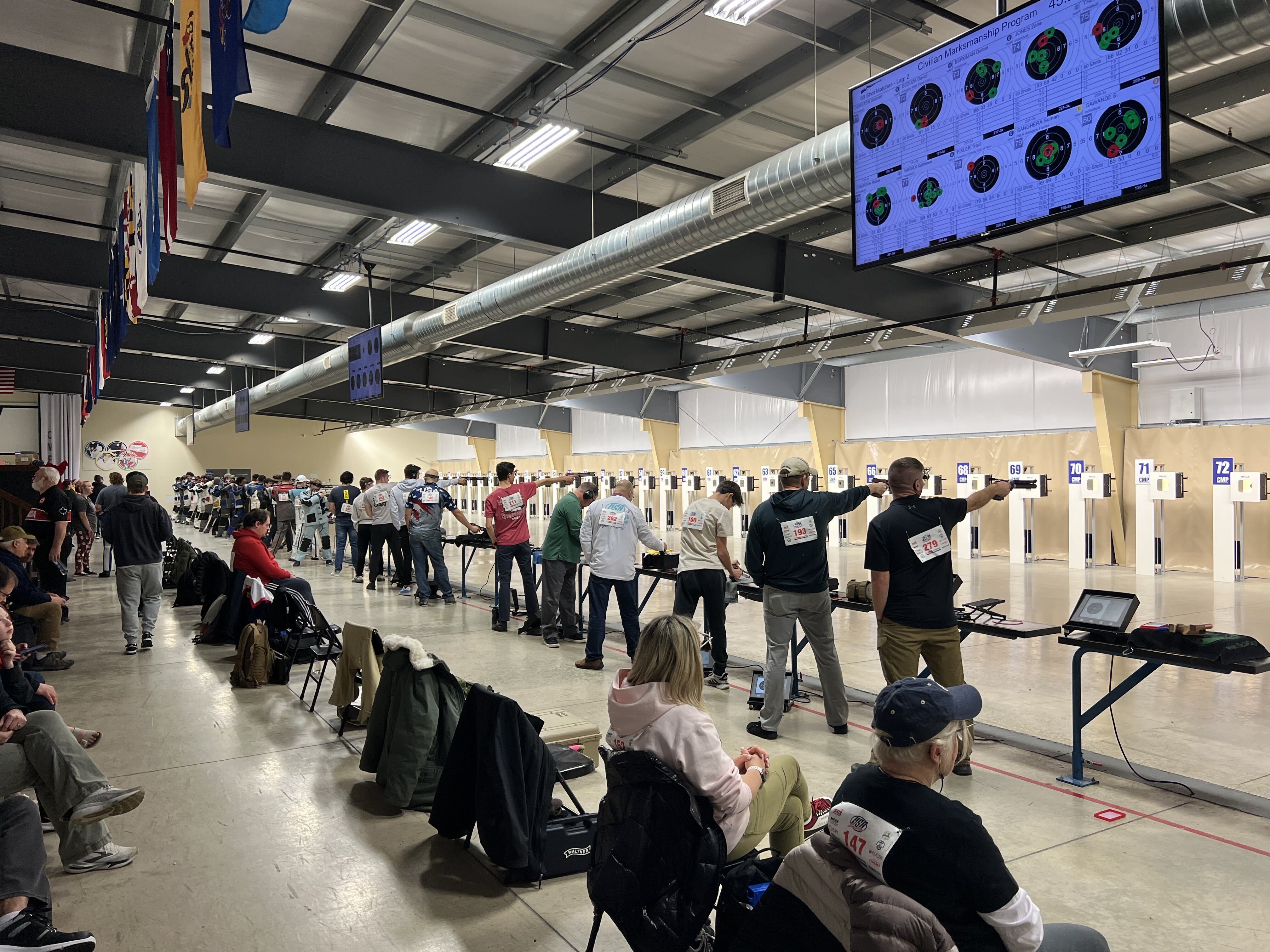
Caption: A sanctioned match line: proper commands, electronic targets, and a field of shooters on the same event as you.
Preface
When I started competing, this information was not readily available, and it would have made things a lot easier. Now, as an equipment vendor, my staff and I have the same conversation all the time, with people picking the sport up for the first time and with experienced shooters arriving from another discipline: they want to compete, but do not know where to find matches, or what is even available in the US.
David Maryakhin, Sport Shooting Depot
This guide is for someone starting out on their own, aiming at a first 10 m air rifle or air pistol match. These are ISSF disciplines: the International Shooting Sport Federation writes the rules. USA Shooting events run under them, and the CMP (the Civilian Marksmanship Program) runs its own air gun rulebook, which follows the ISSF rules closely for the 60-shot events. If you already shoot with a school team, a collegiate program, a junior club or a club team, your coach and your organization handle most of what follows. By the end of the three parts you will know how to find a match, how to enter, and what to expect of the day.
This is the short version, deliberately. The point is to get you to a match quickly rather than to cover everything the sport offers, and to get you to a properly run one. Choosing the Match to Aim At (Section 2, in Part 2) explains why a sanctioned match is a better first target than you might think.
Why Compete, and Why Now
Why a first match is worth entering before you feel ready, and what you get from it.
Most people entering their first match do not feel ready. That is not a reason to wait.
The strongest reason to enter early has little to do with the match itself. It is what a date on the calendar does to the months before it. Training without one drifts. Training with one has a shape, because you are working backward from a fixed point, and that makes every session more purposeful. You understand more of what you are doing, you retain more of it, and you progress faster. The effect starts the day you register, not the day you shoot.
Example: My first match was the Meijer State Games of Michigan, five weeks after I bought my pistol. Those five weeks were harder training than any stretch before them. Nothing had changed about the practice itself. A date was fixed, and I was going to have to walk out on it and perform.
A registration does what an intention does not. Telling a coach or your family that you plan to compete soon does not fix a date. Entering a match does.
The second reason is that the first match is the hardest one, and it is hard almost entirely because it is unknown. Once you have done it, the rest are just matches. Waiting until you feel ready does not work, because that feeling arrives after a first match rather than before one.
What the day itself teaches you is a byproduct rather than the reason to go, but it is a real one. A score shot alone and a score shot on a line with a clock running are different things, and one match will show you more about your weaknesses than a month of comfortable practice. The pressure is difficult to reproduce effectively, especially on your own, and until you have felt it you do not know what you are aiming at. A match is noisy, with people shooting either side of you, movement at the edge of your vision and scores updating around you, and your result is going to sit on a list next to everyone else's. At home you control all of that. At a match you control none of it. Your score will drop, sometimes significantly, and that is normal. Nerves raise your heart rate and unsettle your hold, shots start to feel like they matter so you hold too long or rush them, and an unfamiliar range, light and clock add to it. Expect to finish below your training average, and treat the gap as information: it shows you what to train next. The world's best shooters meet the same distractions and have simply learned to work with them, the same way you will.
The other reason to go is who else is there. Precision shooting is a small and unusually generous community, and everyone on that line is shooting the same event you are. Before the match most people are focused and may not be chatty, so do not read that as coldness. Afterwards is when it opens up, and that is the moment to start a conversation. If the match runs a final and you are not in it, stay and watch from the stands: you see the format before you ever have to shoot one, and the finalists are free and generally happy to talk once they are done. The stands are also where the coaches and parents sit, along with the athletes who did not make the final and the teammates of the ones who did. Once qualification is over, nearly everyone in the building is available, and a question you ask there can save you a year of working something out alone.
And the barrier is lower than almost anyone expects. Club matches, CMP monthly matches and open range nights do not require a paid membership, do not ask for a qualifying score, and do not care how long you have been shooting. You register, you pay a modest fee, and you shoot. The realistic goal for a first match is to finish it knowing what one feels like. Treat your first season as reconnaissance and much of the pressure comes off.
Are You Ready? You Probably Are
The three things that make you ready, and what is not on the list.
Probably, if you have some basic skills and are comfortable operating your gun. Roughly, that means:
- You can handle the gun safely under standard range commands. Muzzle downrange, finger off the trigger until you are ready to fire, and you stop when you are told to stop.
- You can operate your own equipment without help. Loading, filling the cylinder, adjusting your sights. A range officer will answer questions, but they are not there to run your gun for you.
- You have a repeatable process. Some fixed sequence that you follow the same way every time. It does not have to be a polished process, only a consistent one, because under pressure it is the only thing you have to fall back on.
One thing worth doing beforehand, though it is not a requirement. Shoot a full-length course before the day, on the gun you intend to bring, so that the duration is not new to you. A 60-shot match against a clock asks more of you physically and mentally than a comfortable practice session does, and finding that out in advance is useful. On electronic targets the limit is 75 minutes. On paper targets the ISSF rules add 15 minutes, and beyond that the time is at the match organizer's discretion: some matches allow more, and some time each 10-shot series separately, with a short break to change targets in between. The match program will tell you which. Know the upper limit so that you finish inside it. Shooting faster than that is fine, but do not rush: you are still trying to do the best job you can, one shot at a time. If you discover you cannot yet pace all 60 shots inside the time, that is fine. Enter anyway. Pacing is something you can and should train at home. What is harder to train is pacing under match pressure, and until you have experienced it you do not really know what you should be practicing.
It is worth noticing what is not on that list: a particular score, a classification or ranking, a coach, your own gun, special clothing. None of those, and plenty of other things you might assume are required, are conditions of entry. Waiting until you have them keeps you outside a community you could already be part of.
Next in this series. Part 2 covers which match to aim at, the registrations you need, and how to find a match and enter it. It follows in a few days.
Help Us Keep This Guide Current
We keep this guide up to date, and we would appreciate your help with that. Fees, facilities, calendar dates and rules all change. If you spot anything worthwhile that we missed, an error, or a change to the regulations or to anything else we reference, please contact us at sportshootingdepot.com/contact-us. Every note helps us keep the guide accurate and current.
Disclaimer
This guide shares what has worked for us and for other shooters. It is not legal or professional advice. Entry requirements, fees and rules are set by the organizations that run each match, not by us, and they change. You are responsible for following the laws and rules where you live, and for checking the current match program and rulebook before relying on any rule described here.
References
Rules and figures in this guide were verified in October 2026 against the sources below.
Rules
- ISSF Rule Book, Edition 2025 (Second Print 07/2026), effective 1 July 2026: General Technical Rules 6.2.3.1 (range commands), 6.2.5.1 (hearing protection), 6.11.1 (commands), 6.11.2.3 (air cylinders), 6.11.6.1 (crossfire), 6.11.9.1 (scoring), 6.12.5.3 (leaving the firing point), 6.12.6.1 (penalties) and 6.17 (finals); Rifle Rules 7.7.4 and Pistol Rules 8.11 (time limits); Pistol Rules 8.4.1.5 (measuring box).
- ISSF Rifle Equipment Control Guide, Edition 2026, and Explanation of New Pistol Grip Rules 2026, both on the ISSF Amendments and Interpretation page, and the ISSF announcement of the 2026 rule changes, for Section 8.
- CMP Air Rifle and Air Pistol Competition Rules, 5th Edition (2026), effective 1 March 2026.
Programs and calendars
- CMP Competition Tracker, for match listings.
- CMP: Register for a CT Number, for competitor number registration.
- CMP Monthly Match Program, for the monthly match schedule.
- CMP Competition Centers: public shooting, for daily range fees and rental rates.
- CMP Camp Perry Open, for the air pistol entry fee.
- CMP Air Pistol Nationals, Alabama Airgun and Smallbore Cup and the Walther Cup, for open championships.
- USA Shooting events calendar and membership.
- USA Shooting SafeSport, for SafeSport and background check requirements.
Travel
- TSA: Compressed Air Guns, for checked baggage and air cylinders.