
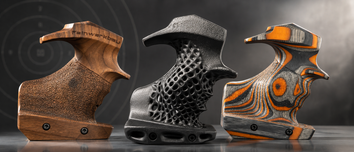
In precision pistol shooting, small inconsistencies produce big results—and the grip is where many of those inconsistencies begin.
Your pistol grip determines how naturally the sights align, how cleanly your trigger finger can move, and whether you can reproduce the same hand position from shot to shot. Even the most advanced match pistol will be difficult to shoot consistently when its grip is the wrong size, shape, or angle for your hand.
Whether you are purchasing your first competition pistol, replacing a factory grip, or refining an established setup, this guide will help you understand what to look for—and what to avoid.
Why Your Pistol Grip Matters
The grip is the primary connection between your hand and the pistol. Its job is not simply to make the pistol comfortable. A properly fitted grip should help you establish the same relationship between your hand, trigger, sights, and bore axis every time you raise the pistol.
A well-fitted grip can help you:
- Improve sight alignment: The pistol should settle into a predictable position without excessive wrist correction.
- Increase consistency: Clear reference points make it easier to place your hand in the same position for every shot.
- Isolate trigger movement: Your index finger should reach and operate the trigger without disturbing the rest of your hand.
- Distribute pressure evenly: The grip should feel secure without creating painful pressure points.
- Reduce fatigue: A more natural hand position makes long training sessions and matches easier to manage.
- Remain competition-compliant: Grip contours and dimensions must meet the rules of your shooting discipline.
A grip that feels soft or comfortable when you first pick it up is not necessarily a grip that will perform well through a full match. Repeatability is more important than immediate comfort.
The Main Types of Competition Pistol Grips
Factory Grips
Most match pistols include a factory anatomical grip in a common size such as small, medium, or large. These grips are a practical starting point and may provide enough adjustment for many shooters.
However, shooters with particularly narrow, wide, short, or long hands may struggle to achieve an ideal fit with the factory options alone.
Aftermarket Anatomical Grips
Aftermarket manufacturers offer grips in a much wider range of configurations. Depending on the manufacturer, you may be able to select:
- Right- or left-handed orientation
- Hand size
- Grip volume
- Flat or rounded profiles
- Different lateral angles
- Adjustable or fixed palm shelves
For example, Rink organizes its standard grips around five primary parameters: size, side, form, angle, and volume. Hand size is measured across the base joints of the fingers rather than around the palm.
This greater range of options can often provide a near-custom fit without the cost or lead time of a fully custom grip.
Custom-Made Grips
A custom grip is created or modified specifically for an individual shooter. This may involve an in-person fitting, duplicating an existing grip, or building from detailed hand measurements.
Custom grips can be especially valuable for shooters with:
- Unusually shaped hands
- Previous hand or wrist injuries
- Significant differences in finger length
- Difficulty reaching the trigger
- Pressure-point problems that cannot be resolved through adjustment
A custom grip is not automatically better than a well-selected standard grip. Its advantage comes from solving fit problems that standard sizes cannot address.
Universal or Ambidextrous Grips
They generally offer less anatomical support than a dedicated right- or left-handed grip, but their versatility makes them a practical choice for introductory equipment.
How to Choose the Right Pistol Grip
1. Start With the Correct Hand Size
Measure across the base of your fingers at the knuckles, following the sizing instructions provided by the grip manufacturer. Do not assume that your glove size will translate directly to pistol-grip size.
A grip that is too small can force your fingers too far around the front of the grip and create excessive pressure. A grip that is too large may prevent your hand from seating fully and make the trigger difficult to reach.
Manufacturer sizing systems are not always identical, so check the chart for the specific brand you are considering.
2. Account for Hand Shape, Not Just Width
Two shooters can have the same hand width but require very different grips.
Consider:
- Finger length
- Palm thickness
- Thumb position
- The relationship between middle-finger length and hand width
- Whether your hand is relatively flat or rounded
Grip volume and contour may matter just as much as the labeled size.
3. Check Your Trigger-Finger Position
With your hand seated normally, your index finger should contact the trigger in the position recommended by your coach and appropriate for your technique. You should not need to rotate your hand excessively or stretch your finger to reach it. Canonical finger placement is middle of the first phalange.
Most importantly, the trigger finger must be able to move without pulling the other fingers, tightening the thumb, or shifting the pistol in the hand.
Before replacing the grip, remember that many match pistols also allow the trigger shoe to be moved forward, backward, or laterally. Grip fit and trigger position should be evaluated together.
4. Evaluate Natural Sight Alignment
Take your normal stance, close your eyes, raise the unloaded pistol, and settle into your usual aiming position. Open your eyes and observe the sights.
If the front sight consistently appears far to one side, the grip angle, rotation, or shape may be encouraging an unnatural wrist position. A small correction may be possible through grip adjustment. A large or persistent misalignment may indicate that a different grip configuration is needed.
Follow all normal range-safety procedures and ensure the pistol is unloaded before performing any fit evaluation away from live fire.
5. Look for Even, Repeatable Contact
The grip should guide your hand into position without forcing it there.
Watch for:
- A gap behind the palm
- Excessive pressure at the web of the hand
- Pain beneath the palm shelf
- Fingertips pressing hard into the grip
- Pressure from the thumb rest that causes the thumb to tense
- Numbness or discomfort during longer sessions
Some contact points are useful because they help establish a repeatable hand position. Sharp pressure, pinching, or numbness are signs that the fit needs attention.
6. Set the Palm Shelf Correctly
The palm shelf should provide a clear lower reference point without clamping the hand.
If it is set too low, the hand can shift vertically between shots. If it is set too high, it can create pressure, restrict circulation, or encourage unnecessary tension.
Your hand can also change slightly during a match because of temperature, humidity, and swelling. An adjustable palm shelf gives you greater flexibility, but every adjustment must remain within the rules for your event.
A Simple Five-Point Grip-Fit Test
Before committing to a new grip, check the following:
- Seating: Can your hand enter the grip fully and naturally?
- Alignment: Do the sights settle close to alignment without forced wrist rotation?
- Trigger reach: Can the trigger finger move independently and comfortably?
- Pressure: Is contact firm and distributed without painful hot spots?
- Repeatability: After releasing and rebuilding the grip several times, does the pistol return to the same position?
Whenever possible, evaluate the grip during live-fire training rather than relying entirely on how it feels at a counter. A good grip should continue to feel stable after dozens of shots.
Factory, Aftermarket, or Custom: Which Is Right for You?
A newer shooter should generally begin with a properly sized factory or aftermarket grip and spend time developing a consistent technique before making extensive permanent modifications.
An aftermarket grip is worth considering when:
- The factory grip is clearly the wrong size
- You need a left-handed configuration
- Trigger reach cannot be corrected adequately
- Natural sight alignment is consistently poor
- The grip produces recurring pressure points
- You need a different angle, volume, or hand shape
A fully custom grip makes the most sense when standard options and normal adjustments cannot solve a specific, repeatable problem.
Avoid changing the grip simply because of one poor training session. Changes should address an identifiable fit or performance issue—not replace sound fundamentals.
Understanding the 2026 ISSF Pistol-Grip Rules
The ISSF’s 2026 clarification introduced specific requirements governing the shape of 10m and 25m pistol grips:
- The rear portion of the grip or frame above the hand—often called the horn—is limited to 40 mm for 10m pistols and 30 mm for 25m pistols, measured according to the ISSF diagram.
- The rear of that horn must angle upward by at least 45 degrees relative to the barrel centerline.
- The grip contour behind the specified reference point must continue in a downward direction. It may not rise, run parallel to the barrel axis, or encircle the hand.
- On the wrist side, the end of the heel or palm rest must be cut at an angle of at least 30 degrees. The edge may have a maximum rounded radius of 2 mm.
The ISSF currently lists its updated 2026 rulebook on its official rules page, with the latest listed printing effective July 1, 2026.
These requirements do not mean that anatomical match grips are prohibited. They mean that certain supportive contours must remain within defined limits. Rink makes a convenient Rules Checker Template.
Rules may also differ between ISSF competition, national federations, collegiate programs, junior leagues, and local matches. Before permanently altering a grip, consult the current rules for the organization conducting your event. When possible, have questionable equipment inspected before competition.
How to Adjust a Competition Pistol Grip
Make adjustments methodically rather than changing several variables at once.
A useful process is:
- Record or photograph the original setup.
- Identify one specific problem.
- Make one small adjustment.
- Rebuild your grip several times.
- Shoot enough shots to evaluate the change.
- Record the result before making another adjustment.
Depending on the pistol and grip, you may be able to adjust:
- Palm-shelf height and angle
- Grip rotation
- Grip rake
- Trigger reach
- Thumb-rest contour
- Localized areas of grip volume
Use removable material for early experiments whenever possible. For example, Grip Putty Silicone is a great substance that is relatively easy to remove (removable will not pull wood fibers when removed while permanent bonds are so tight that removing will most definitely pull wood).
Permanent sanding, carving, or filling should be done gradually, because removing too much material is difficult to reverse. Some options for more permanent grip compounds are:
Always confirm that the pistol still fits the required measuring box and that the modified grip remains compliant. A simple way to verify is with a Pistol Test Box.
Note: Your hand can also change slightly day-to-day or during a match because of temperature, humidity, and swelling. An adjustable palm shelf gives you greater flexibility, but every adjustment must remain within the rules for your event.
Maintaining a Wooden Pistol Grip
Most precision-pistol grips require relatively little maintenance, but basic care can preserve their fit and finish.
- Wipe away sweat after each training session.
- Use a soft brush to remove chalk, rosin, dust, and debris from textured areas.
- Avoid soaking wooden grips or using aggressive household cleaners.
- Store the pistol in a stable, dry environment.
- Periodically check palm-shelf and grip-mounting screws.
- Inspect repaired or modified areas for cracking or movement.
- Recheck the fit when moving between significantly different temperatures or climates.
- Periodically (once or twice a year) reseal wooden and wood laminate with oil (we recommend Scherell’s Stock Oil).
Do not assume that a loose screw is harmless. Even a small shift in the grip or palm shelf can change sight alignment and hand position.
Common Grip-Selection Mistakes
Choosing Based Only on Comfort - A grip can feel comfortable while allowing the hand to move. Look for repeatable positioning and proper trigger access, not softness alone.
Buying the Smallest Grip That Feels Secure - An undersized grip can feel tightly controlled at first but may create excess finger pressure and fatigue.
Using the Palm Shelf as a Clamp - The palm shelf should establish position, not squeeze the hand into place.
Making Too Many Changes at Once - When grip angle, palm-shelf height, trigger position, and material are changed simultaneously, it becomes impossible to determine which adjustment helped.
Copying Another Shooter’s Setup - A grip that works perfectly for an elite shooter may be completely wrong for your hand proportions and technique.
Assuming a New Grip Will Fix Technique - The right equipment supports good fundamentals. It cannot replace consistent grip pressure, trigger control, sight management, and follow-through.
Find the Right Grip at Sport Shooting Depot
The best grip is not necessarily the most expensive or the most heavily customized. It is the one that helps you build a natural, stable, and repeatable shooting position while remaining legal for your event.
Sport Shooting Depot offers competition pistol grips and accessories for shooters at every stage of the sport. Whether you need help selecting a size, comparing grip configurations, or finding an option for a specific pistol, our team can help you narrow down the choices.
Explore our selection of pistol grips and give your shooting hand the fit it deserves!