

Last updated: November 2026. Airline, airport and state rules change often; check them before every trip.
Preface
Why this guide exists and what it covers.
Traveling with a competition air gun in the United States takes more than you would expect. This guide explains how, especially if it is your first time.
It covers domestic air and ground travel within the United States with air guns. It does not cover international travel, or smallbore rifles and sport pistols, which are firearms under federal law and get their own guides.
It is written for anyone traveling with an ISSF (International Shooting Sport Federation) air pistol or air rifle, by air or by car.
The Trip at a Glance
The whole trip in seven steps. Each one points to the section with the details.
1. Before You Travel
The decisions to make before you book: what to do with the cylinder, how to book, and which places to avoid.
The cylinder is where trouble starts. The air gun itself travels in checked baggage without much difficulty. The compressed air cylinder is the gray area.
Our recommendation: ship the cylinder. The Transportation Security Administration (TSA) has published two positions that do not agree. Its What Can I Bring web entry says a compressed gas cylinder can fly only if its valve is removed so the inside can be inspected, and that sealed cylinders are not allowed even when empty. A 2023 interpretive rule in the Federal Register, issued at the request of the competitive shooting industry, allows up to four unpressurized air gun cylinders per person in checked baggage, each no more than 24 inches long, 3 inches in diameter and 0.1 cubic feet in volume. Both are current. The valve on a match cylinder is not user-removable. None of the manufacturers we checked allows the owner to open or repair a cylinder, and Anschütz and Feinwerkbau reserve that work to the manufacturer, so no one at the airport can do it either. TSA staff we have spoken with tell us the rule is applied differently from airport to airport. So whether your cylinder flies comes down to the airport and the officer you get that day. In our experience it usually goes through. The question is whether you want to risk being the traveler who loses a cylinder at the airport and misses a match. Shipping costs far less than a replacement cylinder.
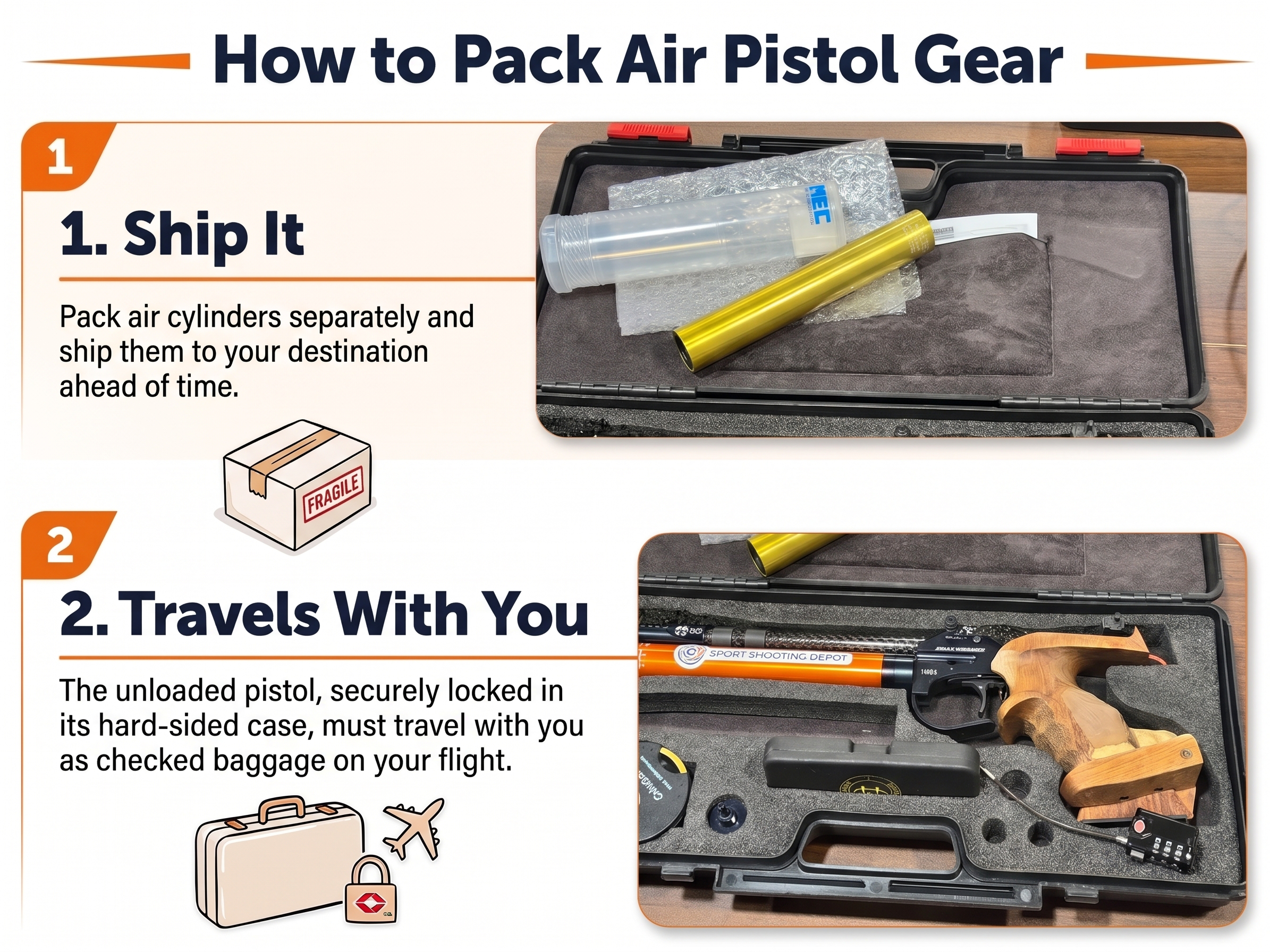
Caption: Diagram instructing to ship the cylinder and check the secured pistol.
Your airline has its own cylinder rule, and it is usually stricter. As of October 2026, no airline we found clearly allows a match cylinder. Delta's firearms page allows empty air cylinders in checked bags, but its sporting goods page requires the regulator valve to be completely disconnected from any compressed gas cylinder. JetBlue lists compressed gas cylinders, including paintball gun cylinders, as not allowed in checked bags. Frontier accepts compressed air cylinders only with the regulator valve completely removed, which a match cylinder cannot meet. Southwest, United, Alaska and Hawaiian, and Sun Country publish the same valve-removed condition for paintball or other cylinders and say nothing specific about air gun cylinders. Until TSA and the airlines resolve this, we advise shipping the cylinder ahead by ground, whatever airline you fly (see Shipping Your Cylinder, Section 3).
If you choose to fly with it anyway, that is your call, and we explain what people do and what can go wrong (see If You Choose to Risk It, Section 7).
Book with buffer time. Do not book the last flight of the day or a tight connection. You must check an air gun in with an agent, which takes longer than a normal bag (Frontier, for example, asks for an extra 30 minutes), and TSA may need to reach you before the flight (see At the Airport, Section 4). A delay can mean missing your flight, and missing your flight can mean missing your match. The more important the match and the more expensive your equipment, the more this matters.
Avoid connections through New Jersey, New York City or Philadelphia. If a connection at Newark, JFK, LaGuardia or Philadelphia is cancelled or diverted, you may have to leave the secure area and reclaim your checked bags, gun included, in a place where possessing it can be an offense (see Know where air guns are treated as firearms, below). New Jersey law also makes carrying a firearm, which there includes an air gun, at an airport a third degree crime unless an exemption applies. Philadelphia's code bans using an air gun or possessing one with intent to use it, and requires police to seize air guns held in violation. Choose a different connection, even if it costs more or takes longer. If your trip changes airlines at the connection, you may also have to claim the gun and check it again with the second airline, so avoid that at these airports too.
Know where air guns are treated as firearms. Under federal law an air gun is not a firearm and needs no registration to own or travel with. A few places treat it as one. These are the strictest places we know of, and the list is not complete:
- New Jersey, statewide. Possessing an air pistol without a New Jersey carry permit, or an air rifle without a New Jersey Firearms Purchaser Identification Card, is a third degree crime unless an exemption applies. The one that matters for a match trip covers carrying the gun directly to or from a range or match, unloaded, in a closed and fastened case or a locked trunk. Whether an overnight stop on the way counts is not settled.
- Rhode Island, statewide.
- New York City, which prohibits possessing an air pistol or air rifle.
Some other cities and states regulate air guns as weapons rather than firearms. In every one we checked, carrying the gun unloaded and cased in the trunk, on a direct trip to or from a match, meets their transport rules.
In California, state law preempts local rules on possessing BB devices and air rifles; Los Angeles County and its cities may be stricter only for devices that look like a real firearm. Rules change in both directions, so check the states on your route and at your destination before you travel. What these places mean for you depends on how you travel (see Avoid connections through New Jersey, New York City or Philadelphia, above, for flying, and Driving, Section 6).
Before you book, check:
- Your airline's firearms and sporting equipment policy. Most airlines that address air guns (Delta, American, JetBlue, Alaska and Hawaiian, Frontier) handle them under their firearm procedures; others do not mention air guns, so ask before you book. The details (forms, case rules, fees) differ.
- The match program, for any travel notes specific to the venue.
Juniors. Most US airlines (Delta, American, United, JetBlue, Alaska and Hawaiian, Frontier, Allegiant, Sun Country) require the person checking a firearm to be 18 or older; Southwest's published policy states no age. Juniors travel with a coach or parent anyway, so that adult checks the gun under their own name. Several states also restrict minors with air guns: New York bars anyone under 16 from possessing one; Massachusetts bars anyone under 18 from having one in a public place unless accompanied by an adult; Pennsylvania bars anyone under 18 from carrying one on highways or public land without an adult, unless it is unloaded in a suitable case, with an exception for supervised club and range use. So the adult carries and transports the cased gun, and the junior handles it only at the range, under supervision.
2. Packing Your Gun
What goes in the case, what goes in your suitcase, and what can ride in your carry-on.
The case. Airlines require the gun to be unloaded and in a locked, hard-sided case. Many shooters use a fitted case with foam cutouts. The case does not need to be labeled.
Use a non-TSA lock. A match gun is delicate and precisely tuned. You do not want anyone opening the case and handling it without you there, and arriving at a match with damaged equipment you cannot fix in time is exactly what this protects against. A TSA lock can be opened with a master key. A non-TSA lock cannot, so if TSA needs to inspect the case, its stated practice for a locked firearm container is to try to contact you, and it may ask you for the key. If it cannot reach you, the case does not go on the aircraft. Any sturdy padlock or combination lock will do, as long as it is not TSA-keyed, including a built-in lock. Put a lock in every lock point on the case: American requires a lock on each end of a rifle case, and Delta, Southwest and Alaska refuse a case that can still be opened while locked.
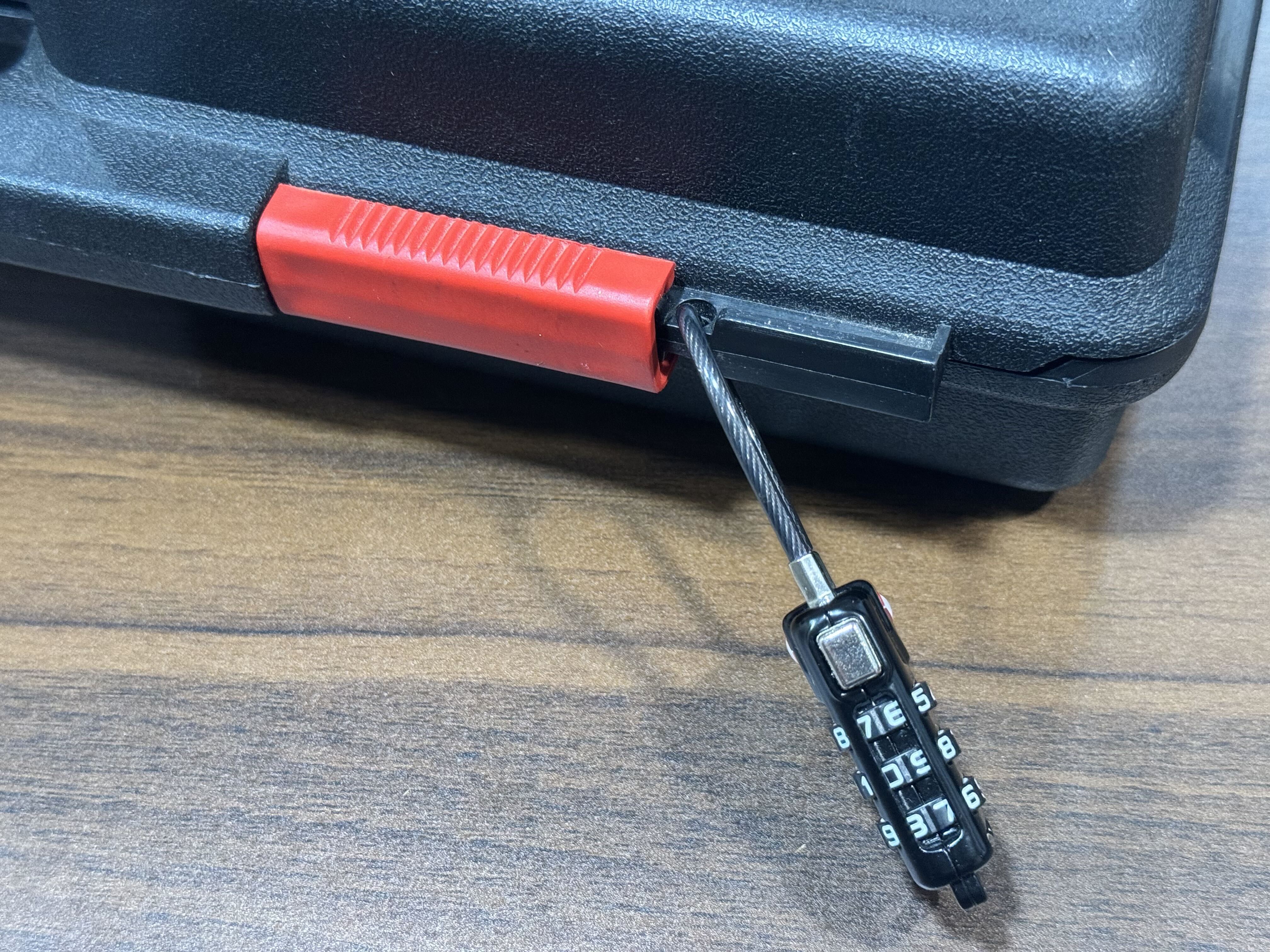
Caption: A non-TSA lock on the gun case
Pistol shooters. Put the locked pistol case inside a larger suitcase. It is less conspicuous on the baggage belt and better protected. Delta, United and Southwest expressly allow this. On Delta the outer bag must be soft-sided and unlocked, with a Conditional Acceptance Tag; on Southwest it can be locked or unlocked.
Rifle shooters. A rifle case is too large for a suitcase, so it travels on its own. It is also better protected. Removable sights can travel separately in your suitcase.
Pellets. Pellets must go in checked baggage, never in your carry-on: TSA's 2023 rule places air gun ammunition in checked baggage, and TSA does not allow ammunition in a carry-on. Lead looks like ammunition on the X-ray, and pellets in a carry-on can trigger a full search of your bag and a delay long enough to miss your flight. Airlines do not say whether they count pellets as ammunition. At least one (JetBlue) requires ammunition in a container separate from the locked gun box, and most airlines limit ammunition to 11 pounds (5 kilograms). The safe course is pellets outside the gun case, in your suitcase with the rest of your gear, under 11 pounds in total. Make sure the tins stay shut: tape the lid or use a rubber band, or better, use clips made to keep the lid from popping open.
Your carry-on. The gun, the cylinder (even empty), pellets and gun parts must go in checked baggage. TSA expressly permits scopes in a carry-on, but does not say whether a removed sight or grip counts as a gun part, so check those. Shooting glasses and clothing are ordinary items, subject to the officer's decision, and carrying them gives you more control over how they travel.
Pro tip: put a tracker in the case. If it is an option for you, a tracker such as an AirTag lets you see where your bag is, at the airport and after you land.
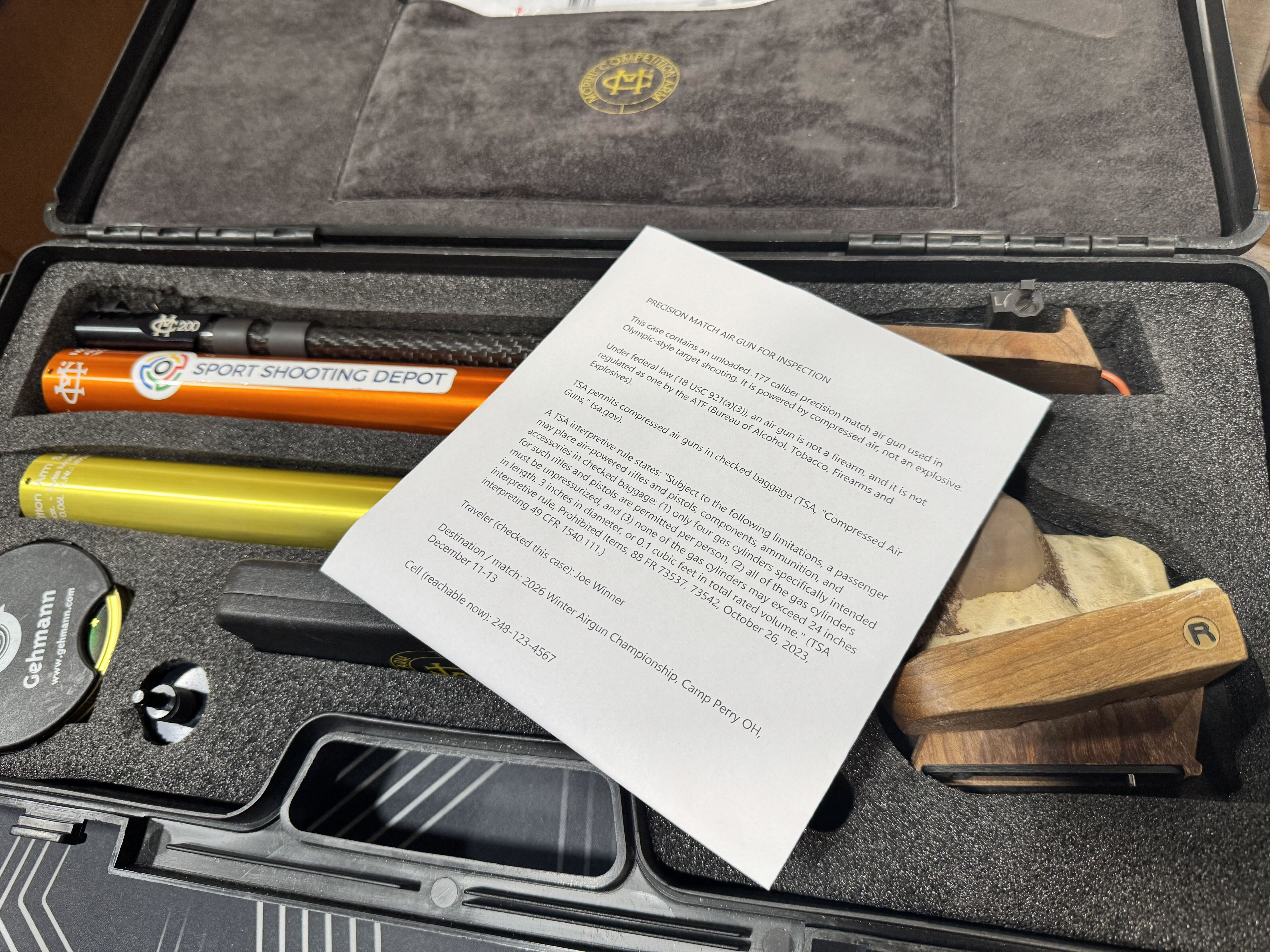
A card to place in your bag. Place this card on top, inside the case. It states plainly what the gun is and cites the rules, so if a question comes up after the bag leaves the counter, the officer has the facts and can reach you. It is not a guarantee: an officer can still apply the stricter rule to a cylinder (see Before You Travel, Section 1). Print it, fill in the blanks, remove the cylinder paragraph if you shipped the cylinder, and check that the cited rules are still current before printing:
3. Shipping Your Cylinder
How to ship the cylinder to the match, and the same way back home.
Shipping works the same in both directions. Send it at least a week before you arrive, and ship it home the same way afterward.
Empty it with the discharge tool. The cylinder must hold no air at all, whether you ship it or fly with it; manufacturers such as Feinwerkbau allow only unfilled cylinders to be shipped or flown. Use the manufacturer's discharge tool (a drain plug, air release screw or adapter, depending on the maker). If your gun did not come with one, buy it from a dealer. Discharge until no more air escapes and, if your cylinder has a gauge, it reads zero, then follow your manual for the final step.
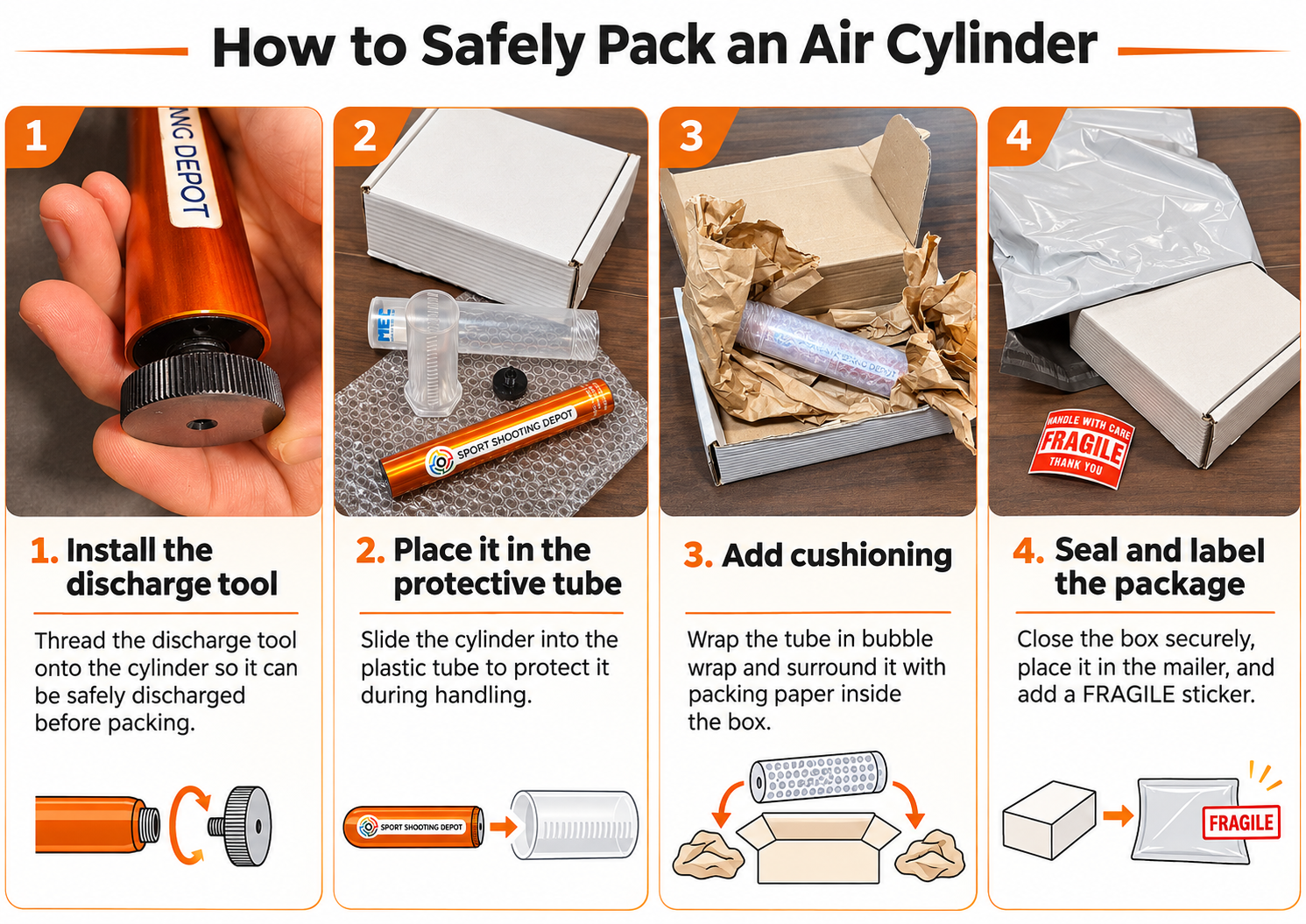
Caption: Step-by-step strip: discharge tool on the cylinder; cylinder going into the protective tube; tube wrapped in bubble wrap; sealed box with a Fragile sticker.
Pack it well. Do not ship a bare cylinder. Put it in a protective cylinder tube (an adjustable plastic tube made for the cylinder), wrap it in bubble wrap or a bubble envelope, and put it all in a box or padded pack. Add a "Fragile" sticker, available at any shipping counter. Keep the tube and box, or pack a prepaid return label, so you can ship it back the same way.
Choose the carrier. Use UPS or FedEx Ground, and confirm with the carrier that it accepts an empty cylinder before you ship. Do not use the US Postal Service (USPS): postal rules treat an empty, used compressed gas container the same as a full one. FedEx Office counters are told not to accept empty cylinders, so ship through UPS or confirm with FedEx first. The UPS Store locations are almost all independently owned franchises, so a store may decline a package, and for a box shipped over a UPS Store counter, UPS deals with the store, not you, on tracking and claims.
What to say. A cylinder emptied to zero is not a hazardous material under federal rules, so nothing has to be declared or labeled, and there is no need to volunteer what is inside. If you are asked, answer truthfully: an empty air gun cylinder, compressed air only. A cylinder still holding about 2 bar (29 pounds per square inch) or more is a regulated compressed gas and must not be shipped this way.
Choose where to ship it. Your hotel, an Airbnb, the match facility, or any address where someone will receive and hold it. Call ahead to confirm they will accept and hold a package for you, track the shipment, and confirm it arrived the day before you get there.
For practical tips on packing, return labels and reusable cases, see Addendum: Shipping Pro Tips, after Section 7.
4. At the Airport
Checking the gun in, and what to expect until you board.
Allow extra time. You must check in with an agent, not online or at a kiosk, which takes longer than a normal bag. Arrive with enough time to check it in and to respond if TSA pages you before your flight (see Book with buffer time, Section 1).
Go to a staffed counter, not a kiosk. You need an agent to accept the gun in person.
Declare it. Keep it to one line:
The agent may ask you to open the case to show the gun is unloaded, and at some airports TSA screens the case at or near the counter. Stay with the case until it is cleared and you have relocked it.
Paperwork. Several airlines (Delta, United, JetBlue, Alaska and Hawaiian, Sun Country) have you sign an unloaded declaration at the counter, so expect to sign something. There may or may not be a fee: no airline we checked charges a special firearm fee, but the case counts as a checked bag, and overweight or oversize charges can apply. Check your airline's current procedures.
Keep it simple. One rule for the counter:
No federal rule expressly requires declaring an air gun, but airlines that handle air guns as firearms require it. Do not argue rules at the counter; answer questions and let the process move.
Listen for pages. Because you use a non-TSA lock (see Use a non-TSA lock, Section 2), TSA needs you or your key to open the case. If it needs to inspect the case after the bag leaves the counter, it will try to reach you, usually by a page. If it cannot reach you, the case does not go on the aircraft. It may never happen, but stay alert to airport announcements until your flight boards.
5. On Arrival
Where to collect the gun, and what to do if it does not show up.
Go to the Baggage Service Office. A checked gun usually does not come down the carousel. Delta requires every checked firearm to be collected at the Baggage Service Office with ID, and Alaska and Hawaiian release rifle and shotgun cases at the baggage office. Other airlines do not say, so check the Baggage Service Office first, sometimes signed as oversized baggage or the airline baggage office, near baggage claim. Bring your claim ticket and photo identification (ID). At some smaller airports the bag comes out on the regular carousel, so if it is not at the office, ask at baggage claim.
If you miss a connection. If your gun reaches the destination before you do, call the airline at that airport and ask them to hold it at the Baggage Service Office until you arrive. If the missed connection is in New Jersey, New York City or Philadelphia, see Avoid connections through New Jersey, New York City or Philadelphia, Section 1.
If the bag does not arrive. File a mishandled baggage report with the airline before you leave the airport, and tell them it contains an air gun so the report is accurate. Some airlines (American, Southwest, JetBlue) require the report within four hours of arrival, and United does not deliver a delayed firearm: you wait for it or come back to the airport. A tracker in the case helps you see where it is.
6. Driving
Driving to a match with your equipment.
Check your route. Check the rules in your home state, the states you drive through, and your destination. In most states a match air gun is not defined as a firearm, but some states and cities regulate it as a weapon or treat it as a firearm (see Know where air guns are treated as firearms, Section 1). Where you stay overnight matters too, and it is not always the same answer as the car: some transport exemptions cover only the drive itself.
Keep it locked and out of reach. The gun and cylinder go together in a locked, hard-sided case in the trunk, out of sight, with the cylinder padded so nothing shifts. Federal hazardous materials rules do not apply to carrying a cylinder in your own car, but some manufacturers (Morini, for example) require the cylinder to be emptied before any transport. Follow your gun's manual. If it allows a charged cylinder, keep it out of the heat: manufacturers set a maximum temperature for a filled cylinder (50 °C, 122 °F, for Morini and Walther; 70 °C, 158 °F, for Feinwerkbau), and a closed trunk in summer can exceed the lower figure.
Keep pellets separate. We found no state law that requires pellets to be carried apart from an air gun. What the strict places require is that the gun be unloaded and cased, and keeping pellets out of the gun case removes any argument about that.
Keep your receipt. A purchase receipt or proof of ownership in the case is optional, but it does not hurt.
If you are pulled over. Treat it the way you would with a firearm: stay calm, keep your hands visible, and do not reach for anything. If asked, say plainly that you have an unloaded air gun in the vehicle. In New Jersey, Rhode Island and New York City the stakes are higher (see Know where air guns are treated as firearms, Section 1). If you can, route around them.
7. If You Choose to Risk It
What some travelers do anyway.
We do not recommend this. If you do it anyway, here is how to reduce the risk. We cannot guarantee it will go smoothly: depending on the airline and the officer, you may lose your cylinder or face questions you do not want on the way to a match.
Flying with the cylinder. We do not recommend this on any airline. Delta's firearms page is the only published airline support for it, and Delta's own sporting goods page contradicts it (see Your airline has its own cylinder rule, Section 1). On any airline other than Delta, do not fly with it. If you do it on Delta, you are relying on that one page and on TSA's 2023 rule (see the case card, Section 2). It usually goes through. But if an officer applies the stricter rule and demands the valve be removed, there is no way to comply: the valve is not user-removable. The cylinder does not fly, and you should not expect to get it back. If you do it, empty it with the discharge tool, take it off the gun, and if asked, say it is empty and show it (the gauge, if fitted, reads zero). Under TSA's web entry a zero gauge reading does not count, so this helps only if the officer applies the 2023 rule.
Do not leave the cylinder attached. Some travelers leave the empty cylinder screwed onto the gun and say nothing, hoping it reads as part of the gun. We do not recommend it. TSA's Compressed Air Guns entry says the gun flies "without compressed air cylinder attached," and TSA staff we have spoken with say the same. If you fly with the cylinder, detach it and pack it in the case.
If you fly with a cylinder in the case, attach this tag to it:
Addendum: Shipping Pro Tips
What we have learned from shipping cylinders to matches and back.
Print the return label before you leave. Put a prepaid return label and a roll of tape in the box with the cylinder. On the way home you reseal the box and drop it at any UPS location, with no hunting for a shipping counter near the venue on match day.
Ship often? Use a reusable case. A small hard case with foam, sized for the cylinder in its tube, survives many trips and packs faster than a new box each time. A rifle shooter's case can hold the main cylinder and a spare. Tape the label to the case, or put the case inside a plain box if the counter prefers that.
Cap it. If your cylinder came with caps for the valve and the filling port, put them on so dirt cannot get into the threads.
Pack it so nothing moves. Fill every gap, with a couple of inches of cushioning on all sides. Close the box and shake it: nothing should shift. Use a new box, or remove every old label from a reused one.
Put your details inside. Add a card in the box with your name, phone number, and the match name and dates, in case the outside label is damaged.
Take photos. Photograph the cylinder and the packed box before you seal it. If it arrives damaged, the photos support your claim.
Declare the value. Carriers limit what they pay for a lost or damaged package unless you declare a higher value; UPS, for example, limits its liability to $100 per package. A match cylinder is worth declaring at its replacement cost.
Address it clearly. For a hotel, write "Hold for guest [Name], arriving [date]" on the label, and call ahead as described in Shipping Your Cylinder, Section 3.
Give big matches more time. For an important match, ship two weeks ahead rather than one, so a delay does not leave you without a cylinder.
Help Us Keep This Guide Current
We keep this guide up to date, and we would appreciate your help with that. Airline, airport and state rules all change. If you spot anything worthwhile that we missed, an error, or a change to the regulations or to anything else we reference, please contact us at sportshootingdepot.com/contact-us. Every note helps us keep the guide accurate and current.
Disclaimer
This guide shares what has worked for us and for other shooters. It is not legal or professional advice. Travel rules vary by airline, airport and state, and the final decision at the airport rests with TSA and the airline. You are responsible for following the laws and rules where you live and wherever you travel, and for checking current airline, TSA and state rules before every trip.
References
Rules and figures in this guide were verified in October 2026 against the sources below.
Federal law and TSA
- 18 USC 921(a)(3), definition of "firearm"
- 27 CFR 478.11, ATF definition of "firearm" (expels a projectile by the action of an explosive)
- 49 CFR 1540.111, carriage of weapons in checked baggage
- TSA interpretive rule, Prohibited Items, 88 FR 73537 (October 26, 2023); air gun paragraph at 73542
- TSA: Small Compressed Gas Cartridges (valve must be removed; gauge reading does not count)
- TSA: What Can I Bring, firearms category (Compressed Air Guns entry; scopes allowed in carry-on; gun parts not)
- TSA: transporting firearms and ammunition (key retained unless TSA requests it)
- TSA fact sheet: firearms and ammunition (if the owner cannot be reached, the container does not fly)
- TSA: Pellet Guns (check with your airline; follow the firearm guidelines)
- TSA: travel tips (TSA-recognized locks and master keys)
Shipping a cylinder
- 49 CFR 171.1(d)(6), hazardous materials rules do not apply to an individual's non-commercial transport in a private vehicle
- 49 CFR 173.115(b), when a compressed gas is regulated (200 kPa, about 29 psig, or more)
- PHMSA Interpretation 11-0287 (uncharged, unpressurized air gun cylinders are not hazardous materials)
- USPS Publication 52, section 342.22 (empty used containers mailable only under the same restrictions as when filled)
- UPS Tariff / Terms and Conditions of Service (inspection right; Third-Party Retailer handles claims; liability limited to $100 unless a higher value is declared)
- FedEx Office Commodity Restrictions Guide (empty cylinders not accepted at counters; marked for internal use)
- The UPS Store (locations independently owned and operated by franchisees)
Manufacturers
- Feinwerkbau: service FAQ (never open a compressed air cylinder)
- Feinwerkbau: compressed air cylinder information sheet (repairs, valves and gauges by the manufacturer only; temperature range for filled cylinders, +70 °C; only unfilled cylinders may be shipped or flown)
- Anschütz: may compressed air cylinders be serviced and repaired by the user? (only the manufacturer may work on them)
- Anschütz: how to vent and empty a compressed air cylinder
- Morini: compressed air cylinders FAQ (shooter solely responsible; no liability for modified parts)
- Morini: CM 162EI manual (empty the cylinder before any transport; 50 °C limit)
- Walther: LG500 manual (never expose filled cylinders above 50 °C)
State and local law
- New Jersey: N.J.S.A. 2C:39-1(f) (definition of "firearm" includes air guns), New Jersey Legislature statutes database
- New Jersey: 2C:39-5b and 5c (air pistol without a carry permit; air rifle without a Firearms Purchaser Identification Card), current text reprinted in 2026 bill S1500
- New Jersey: 2C:39-6f and 6g (match travel exemption and conditions), P.L.2017, c.110
- New Jersey State Police: places where carrying a firearm is prohibited, including airports (2C:58-4.6a(20))
- Rhode Island: R.I. Gen. Laws 11-47-2(7), definition of "firearm" (includes air rifles and air pistols)
- New York City: Administrative Code 10-131(b), air pistols and air rifles
- New York: Penal Law 265.05 (under 16 may not possess an air gun)
- Massachusetts: G.L. c. 269, s. 12B (minors with air rifles in public places)
- Pennsylvania: 18 Pa.C.S. 6304 (minors carrying air rifles; cased and range exceptions)
- Philadelphia: Philadelphia Code 10-810(3)(a) and (8), use or possession with intent to use; seizure
- California: Government Code 53071.5 (state preemption; Los Angeles County exception limited to look-alike devices)
Airlines
- Delta: ammunition, explosives and firearms (air guns handled like firearms; empty air cylinders allowed in checked bags)
- JetBlue: prohibited items (compressed gas cylinders, including paintball gun cylinders)
- Southwest: paintball and airsoft guns (cylinders only with the regulator valve disconnected)
- United: sports equipment (cylinders empty with the regulator removed)
- Delta: sporting and leisure goods (compressed gas cylinders only with the regulator valve completely disconnected)
- Delta: sporting equipment (declaration, locks, Baggage Service Office pickup)
- American Airlines: firearms and ammunition
- United: firearms
- Southwest: checking guns
- JetBlue: traveling with a firearm
- Alaska Airlines and Hawaiian Airlines: transporting firearms (connecting carriers; paintball cylinders)
- Sun Country: Contract of Carriage, Rule 195
- Frontier: fragile and special items (firearms, extra 30 minutes at check-in, cylinders with regulator valves removed)
Lost or delayed bags